TimeLine Theatre Company  
Current SeasonTicketsDirectionsDonate
HomeThe CompanyProduction HistoryWork with UsContact Us
Production History
Current Season


Widowers' Houses at the TimeLine Theatre

by Dan Zeff
ILLINOIS WIRE

CHICAGO — "Widowers' Houses" was George Bernard Shaw's first play. He started it in 1885 and set it aside until completing it in 1892. The drama set the tone for what was to come from the great man for more than 60 years — witty dialogue, challenging ideas, and forceful characters. Shaw wrote many plays better than "Widowers' Houses," but his debut as a playwright still holds the stage surprisingly well, especially in the scintillating revival by the TimeLine Theatre.

"Widowers' Houses" is part drawing room comedy and part social criticism. The criticism attacks one of the most infamous social problems of Victorian England, the slum squalor of the big cities and the middle and upper people to own them, from a safe social distance.

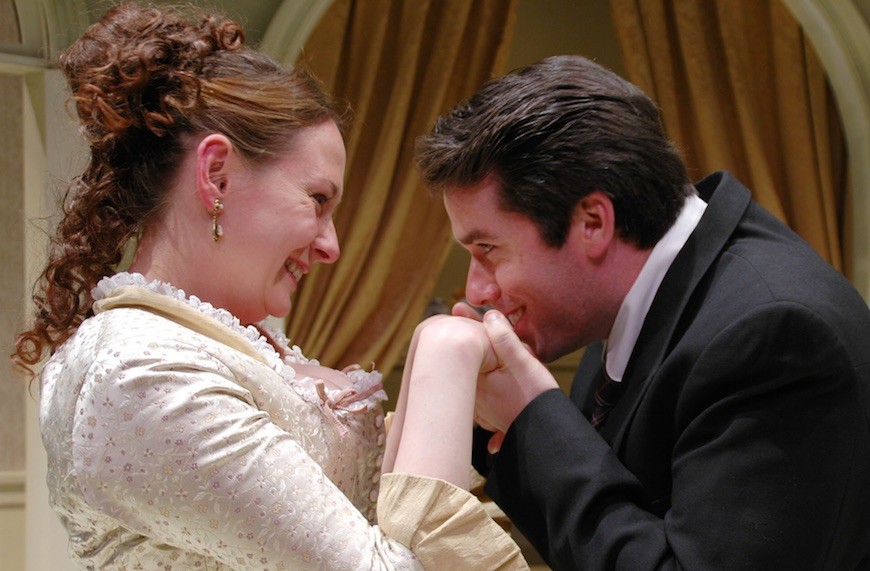
The play begins as the kind of sophisticated comedy that might come from an Oscar Wilde or a Somerset Maugham. A romance has blossomed between strong willed Blanche Sartrorius and young doctor Harry Trench under the proprietary eye of Blanche's wealthy father William. There is much bright conversation among the three plus Trench's pompous friend William Cokane. The play takes its serious turn when the audience learns that source of the Sartorius fortune comes from the man¹s ruthless exploitation of London slum property.

Trench discovers the roots of Sartorius's money and refuses to accept any financial assistance from the man after he marries Blanche, to the indignation of the young woman, who is ignorant of how her father acquires his wealth. Their engagement is broken off but the couple are reunited at the end, after much discussion of the poor and their housing and how to capitalize further on the situation.

With true Shavian perversity, Sartorius makes no apologies for his treatment of the poor. He even sees himself as a kind of public benefactor, putting roofs over the heads of the impoverished who would otherwise be left in the cold. As to why he never makes even the most basic improvements in his properties, he claims the residents would demolish any upgrading in their housing in a matter of days, wasting his money and forcing him to raise the rent for people already at the economic breaking point.

Sartorius's self justification can be heard to this day among private and government owners of inner city housing. They insist that residents don't know how to live in better accommodations and would reduce any improved living conditions back to a slum level because they don¹t know any better and have no respect for property.

There is a fifth major character in the play, a man with the Dickensian name of Lickcheese. He starts out as Sartorius's servile rent collector, fired because he spent a small amount of Sartorius's money to repair a dangerous staircase in one of his employer¹s slum dwellings. Lickcheese is a kind of Alfred Doolittle type, low born but crafty and a survivor. He resurfaces later in the play as a rich self made man, shrewd and amoral enough to cash in on the slum game to his own advantage.

"Widowers' Houses" is as much about the English class system as the deplorable living conditions of the poor. Trench at first takes the high moral ground in refusing Sartorius's tainted money, but he learns that he has been drawing his income from mortgages on such property. At the end of the play, Trench joins Sartorius and Lickcheese in a new scheme to profit from the housing market, improving the houses so they can be sold at twice their value to the local government who will knock down the buildings to make way for new streets. Shaw summarizes his play by stating "I have shown middle class respectability and younger son gentility fattening on the poverty of the slum as flies fatten on filth."

The financial wheeling and dealing in "Widowers' Houses" may be perplexing to today's audiences, but the ins and outs of mortgages are not the point. In Shaw's eyes, the upper classes feed off the misery of the lower classes, justifying their actions without shame simply as good business.

The plight of Victorian England's urban poor is pretty distant from modern American sensibilities, but Shaw's delicious way with language still is as entertaining and invigorating as ever. Blanche Sartorius is one of his most delightful female creations, hot-tempered, hot blooded and unafraid of discarding Victorian prudery in the pursuit of her man. Kathy Logelin is a joy in the role, cunning and temperamental and selfish but somehow sympathetic.

The TimeLine production has cast all the male roles to perfection from the deep pool of company actors. TimeLine has distinguished itself many times before with its revivals of urbane modern English plays and the troupe can add "Widowers' Houses" to its list of ensemble triumphs. P. J. Powers plays the confused Harry Trench like a young Brian Bedford. Mark Richard established himself years ago as one of the drollest comic actors on the Chicagoland scene and he's true to form as Cokane, a perfect caricature of the proper English gentleman.

As Sartorius, David Parkes assumes a startling pompadour hairstyle for no discernable reason, but his coiffeur doesn't distract from a wry performance that turns villainy into proper business conduct without a moral qualm. Terry Hamilton is a scene stealer as Lickcheese, a sniveling Cockney in his first scene and an expansive man of the world at the end of the play, which demonstrates what an infusion of money can do to improve a character's confidence and standing in society. Liza Fernandez rounds out the ensemble as Sartorius's bulled and terrified parlor maid.

Director Kevin Fox properly recognizes that the strengths of the play reside in its comic drolleries and gets the most out of Shaw's humor while still keeping the social criticism in focus. The scenery by Brian Sidney Bembridge and the costumes by Rachel Anne Healy credibly recreate the upper class English world of the 1890's. Keith Parham designed the lighting and Andrew Hansen designed the sound and composed the original music.

"Widowers' Houses" runs through July 1 at the TimeLine Theatre, 615 West Wellington Avenue. Performances run Thursday and Friday at 8 p.m., Saturday at 4 and 8 p.m., and Sunday at 2 p.m. Wednesday evening matinees begin on May 30. Tickets are $25. Call 773-281-8463.

The show gets a rating of four stars.


игра шарики