Hauptmann
back
to Hauptmann home
Review of Hauptmann
Hauptman puts the justice system on trial
- Recommended
reviewed by Hedy Weiss
Chicago Sun-Times
2/11/03
One of the most intriguing
aspects of theatrical revivals is the way they reveal
a play's subtle shifts in meaning and emphasis, as certain
elements come into sharper relief and others seem to
recede, depending on the particular events and preoccupations
of the moment.
TimeLine Theatre's highly polished
revival of "Hauptmann," the careermaking 1986
drama by Chicago-based writer John Logan (more recently
known for his work on Hollywood films, including "Gladiator")
could not come at a more opportune moment, as questions
about capital punishment and the serious flaws in our
legal system are being examined both in real life and
on the stage.
Like "The Exonerated," the
current fragmented, documentary-style national touring
production that considers the fates of several innocent
men and women who were sent to Death Row but later cleared,
"Hauptmann" explores a deeply flawed investigation
and trial. Here it is the notorious case of Bruno Richard
Hauptmann (played by PJ Powers), the undocumented German
immigrant who was accused and ultimately convicted of
the 1932 kidnapping and murder of the 20-month-old baby
of Charles Lindbergh (Gerrit O'Neill) and his elegant
wife, Anne Morrow Lindbergh (the well-cast Tiffany Scott).
In its initial staging, "Hauptmann"
seemed to focus more strongly on the media circus surrounding
the case, and on the sharp class division between Lindbergh,
the world-famous aviator whose solo flight from New
York to Paris in 1927 turned him into America's golden
boy, and Hauptmann, the ever-struggling immigrant and
outsider. And it emphasized the way Lindbergh and his
wife seemed as gilded as the film images of Fred Astaire
and Ginger Rogers, while Hauptmann and his devoted "frau,"
Anna (the very believable Pat Teidemann Hofmann), could
only dream about such a glittering, privileged existence.
In director Nick Bowling's carefully
tuned TimeLine staging of the play—which skillfully
reveals the complex, airtight structure of Logan's work—it
is the manipulative and highly questionable police work
and legal proceedings that stand out most starkly. Yet
while the drama plants many doubts about the handling
of the case—and leaves you with as many questions
as answers—it also makes you think that the authorities
may very well have caught the right man, even if several
other men (and perhaps a woman) were also heavily involved
in the crime.
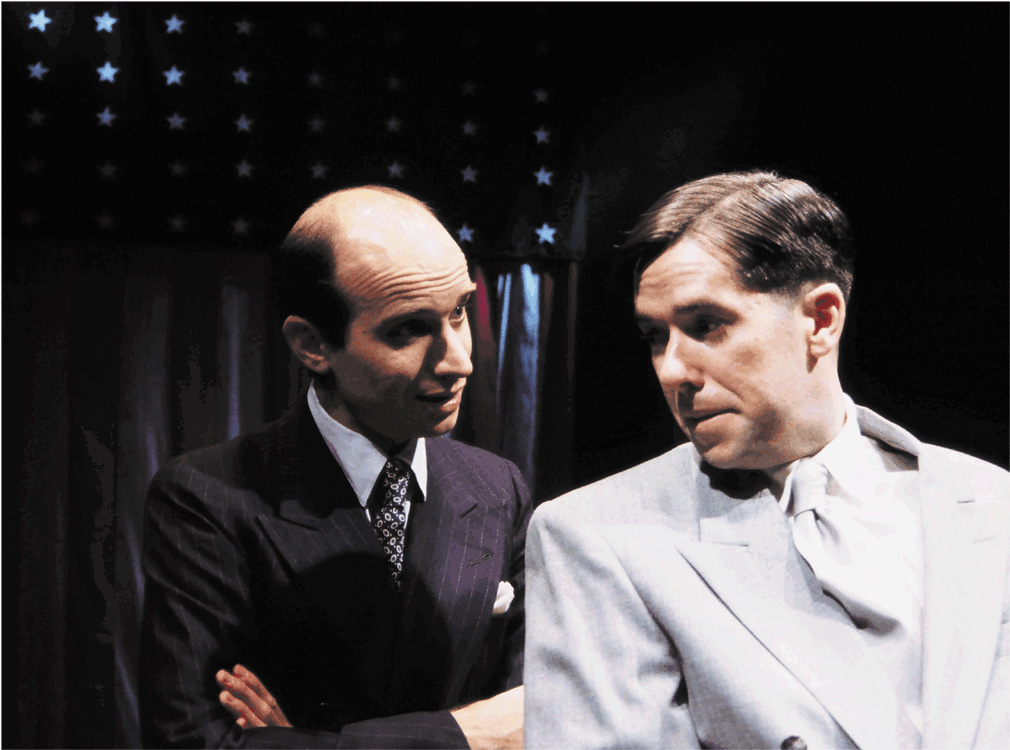
The play, staged on a compact circle
of ascending platforms that makes the audience feel
as if it's the jury, unspools through Hauptmann's eyes
(and often bitingly ironic narration), as he awaits
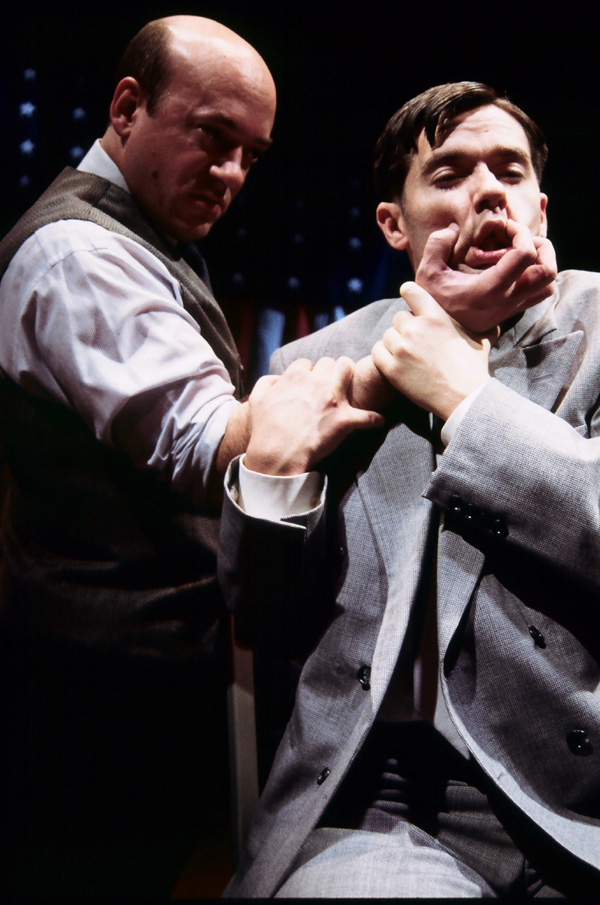
his walk to the electric chair in 1936. As he looks
back on events, we see his life in the hours before
his arrest, the strange ransom trysts, his lack of legal
assistance during police questioning and the circuslike
atmosphere surrounding the trial for what was hyperbolically
dubbed "the crime of the century." (There
is even a glimpse of the little replicas of the kidnapper's
ladder that were hawked outside the New Jersey courthouse
where the trial took place.)
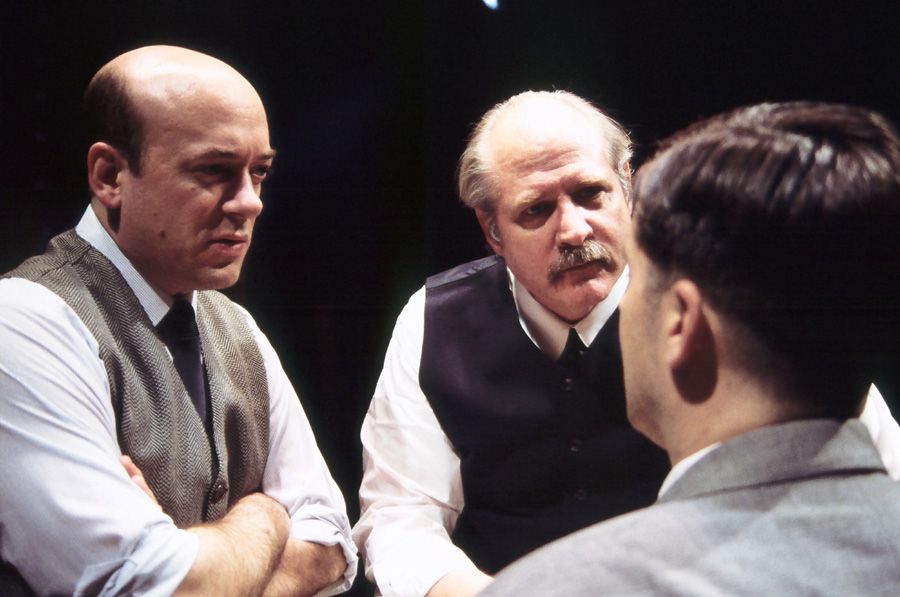
In addition, we hear from the slew
of less-than-reliable witnesses (all played deftly by
Thomas Edson McElroy) who were called to the stand by
the hotshot prosecuting attorney Wilentz (precise, dynamite
work by Matthew Krause) and supported by the Judge (Bill
Bannon). In the process, we also get to know something
about the two couples whose fates are irrevocably intertwined.
And we get a feel for the temper of the times—the
Great Depression at home, the rise of Hitler in Europe,
the general fear of immigrants, the superheated newspaper
wars.
Although PJ Powers' German accent
is a sometimes thing, his quietly shifty, often insolent
portrayal of Hauptmann has a fine trapped rat quality,
full of ambiguity and self-righteousness. He also neatly
portrays his own blusteringly inept and often alcoholic
lawyer.
The boldly emblematic set and lighting
design by Heather Graff and Richard Peterson, the 1930s
period outfits by Nicole Rene Burchfield and the fine
sound design by Andrew Hansen all fuel the engine of
"Hauptmann." And, in what has become a bonus
element of every TimeLine production, there is an exceptionally
handsome lobby display that supplies a fascinatingly
detailed history of the case.
|