"Beckett was one of the great playwrights of his generation ... it was an opportunity of a lifetime"
— An
interview with John Jenkins
back
to Harmless
TimeLine's world premiere production of Brett Neveu's Harmless features a remarkable cast of three actors who walk the tightrope of Neveu's script with commitment and skill. TimeLine company member and marketing director Lara Goetsch (LG) interviewed all three of them so you could hear more about their background and what it's been like to tackle Harmless.
Our final interview is with John Jenkins (JJ), who with Harmless tackles his first on-stage role in more than a decade. John is a professor of acting at The Theatre School at DePaul University, where the six founding members of TimeLine met as students. Read his complete biography here.
(LG) Please fill us in on your background. What inspired you to pursue a career in the theater, and what ultimately brought you to Chicago?
| |

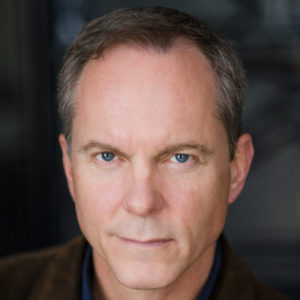
John Jenkins
|
(JJ) It was literally an accident. I was in my senior year in high school and I had a bad accident on a horse — fell off a horse and hurt my leg. Normally I would have been on the basketball team, but I couldn’t play that year, and I needed something else to do. I grew up in a little town in Kansas — population about 1,000 — and attended a very small high school. In my senior year my little high school joined with two other schools to form a new consolidated high school that offered some new programs. One of the new things was a theater and speech program. And since I had some extra time I got involved and I loved it.
I remained interested and involved in theater in college but it wasn’t until my senior year that I decided it would be my career path. I decided to go to the University of Minnesota in Minneapolis for graduate school. This was in 1967. When I left graduate school I started a little theater company with some other students from the University of Minnesota called the Anyplace Theatre, which was in existence for a short time. After a short period of study abroad in the former Yugoslavia I returned to Minneapolis and went to work for the Children’s Theatre Company and worked for them until 1975. I took a leave of absence to go to Chicago — I wanted to study the Alexander Technique and there was a teacher-training program here then. I thought I would eventually return to Minneapolis and the Children’s Theatre Company, but that leave of absence has gone on for a long time!

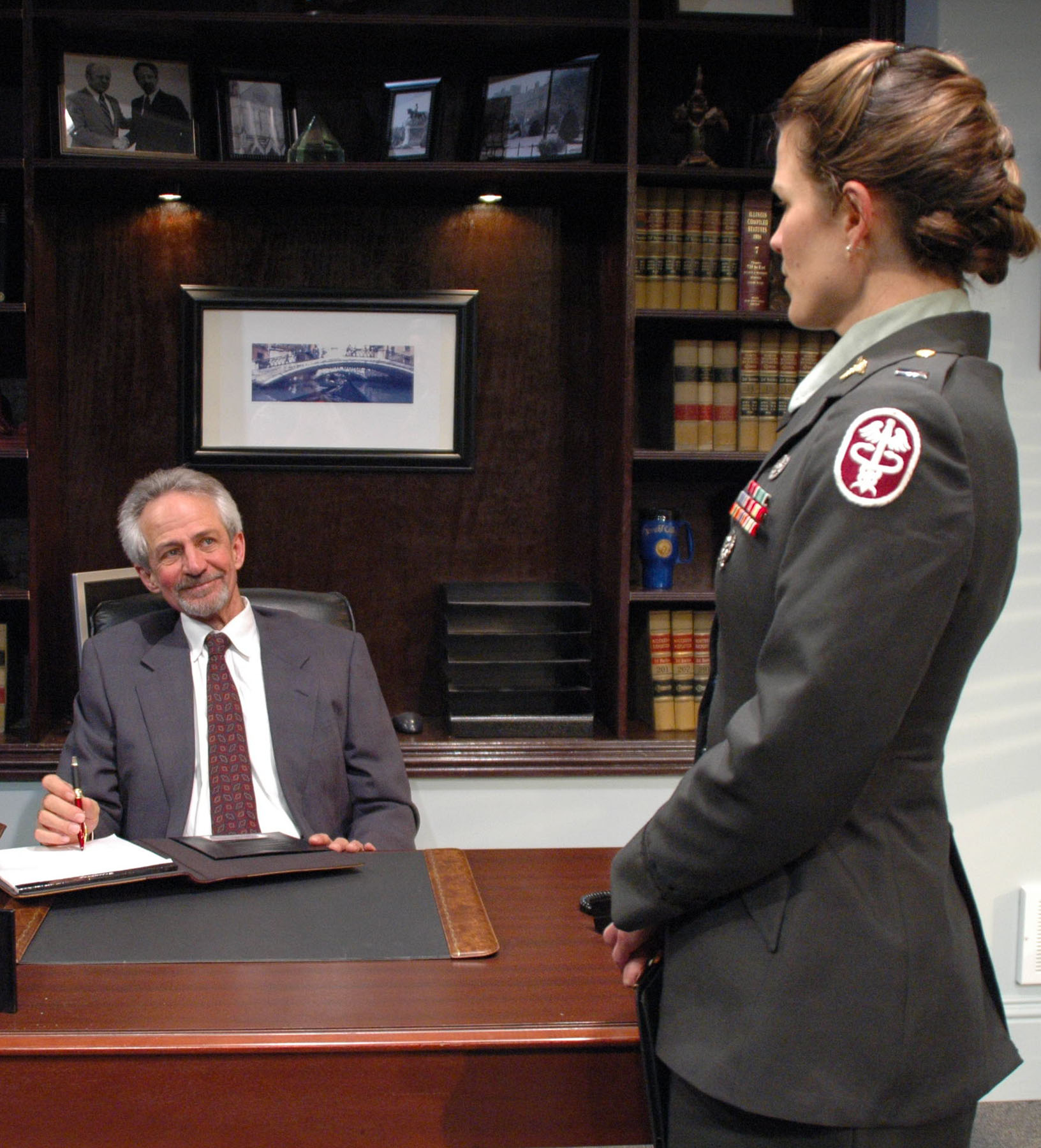
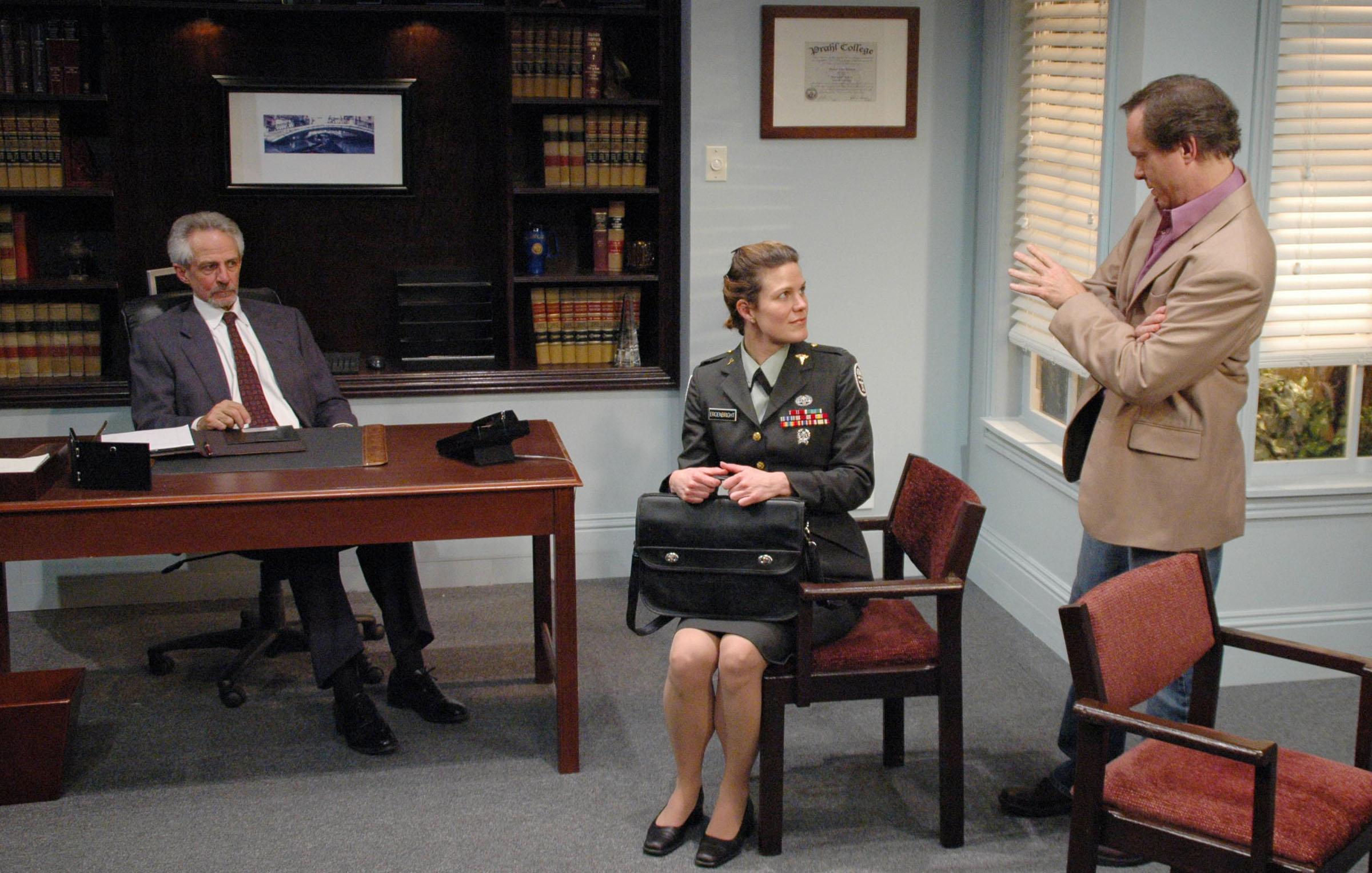
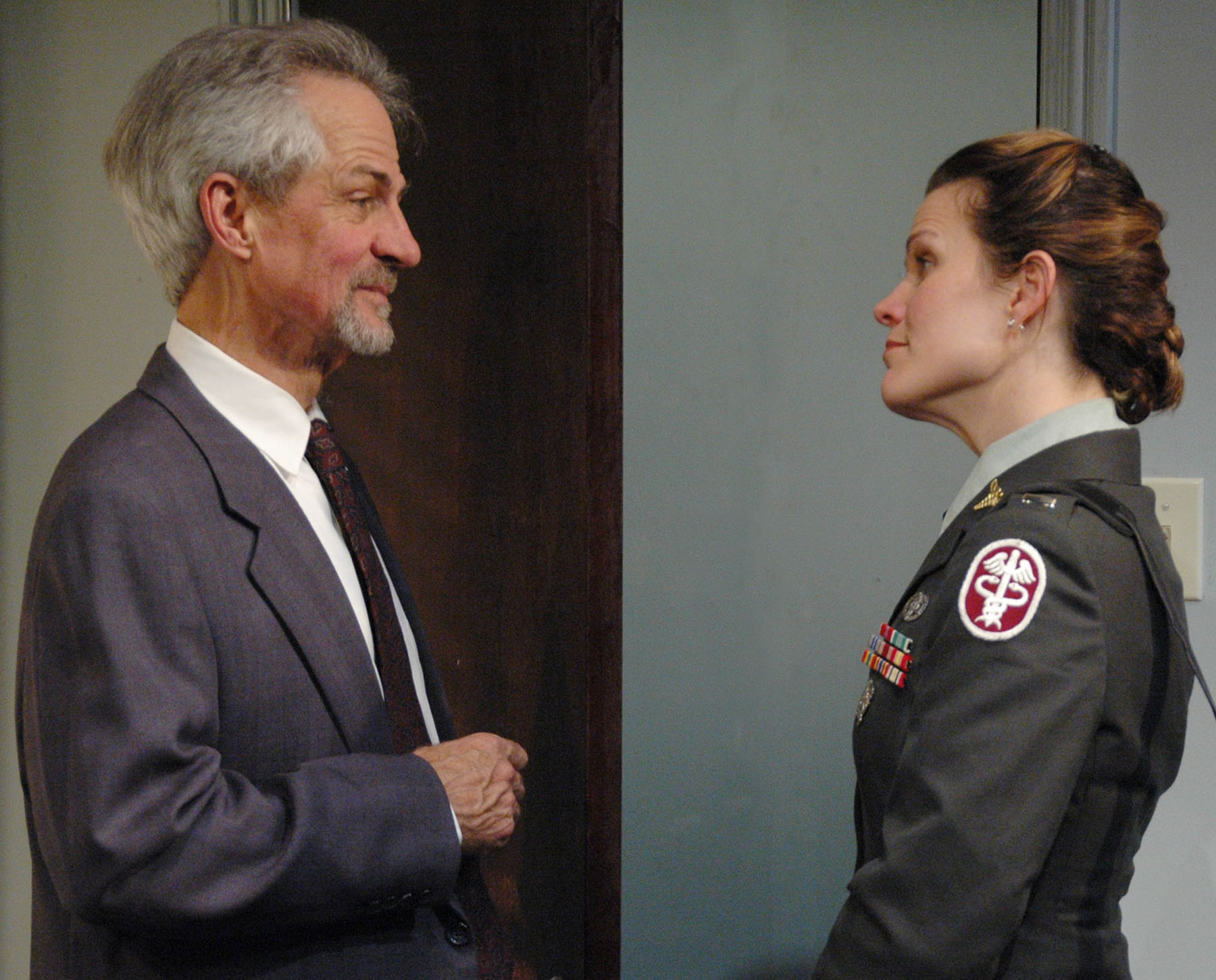
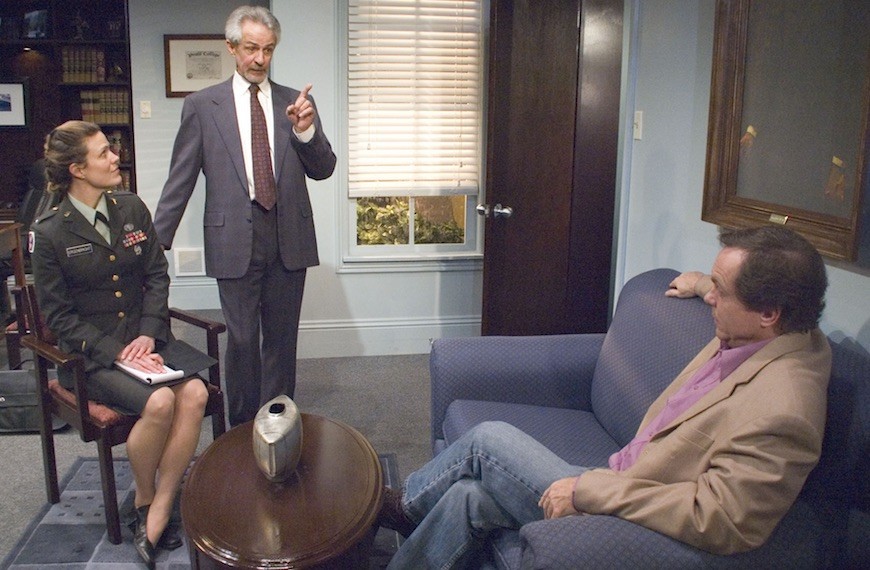
John Jenkins appears as Prahl College President Daniel Wesson in Harmless.
|
|
(LG) Your biography hints at some extraordinary experiences, especially your work with Samuel Beckett and the San Quentin Drama Workshop. Can you tell us more about the Workshop and your adventures with them?
(JJ) Yes, well, I began studying in this training program for the Alexander Technique in Chicago. For the first year I didn’t do any theater, and I started to miss it. Around this time I met Rick Cluchey, who ran a company called the San Quentin Drama Workshop that was based in Chicago temporarily.
The group had started in San Quentin prison. It was inspired by a production of Waiting for Godot, which was performed by the San Francisco Actors Workshop inside the prison in 1957. The production had a profound effect on the prison community. A few prisoners went to the warden and asked if they could start a theater company, and the warden agreed. The company produced a full season of plays and existed for about 10 years. Various theatre artists from San Francisco helped train the company. Rick Cluchey was one of the founders of the Workshop. He became a skilled actor, playwright and eventually the artistic director. When he got out of prison in the late 1960s, the Workshop began to tour. The tours included Europe and while in France, Cluchey met Samuel Beckett and they became friends.
Initially the San Quentin Drama Workshop consisted of people who had been in prison, but by the time I hooked up with them that was not the case. I mean, my involvement didn’t have anything to do with crime! Well, a crime of opportunity, perhaps.
So, soon after I met Rick Cluchey, I went to work for him. The Workshop was headquartered in the Uptown community — one of the things we did there was to help the American Indian Center start a theater company called Echo Hawk Theater — this was around 1976-77, a company that we trained and helped produce.
In 1977, Cluchey was awarded a large stipend from the West German government to spend a year in Germany, in West Berlin, writing and producing plays. He accepted the stipend and we all agreed to go over there and work with him there for a year. He had been in communication with Sam Beckett and persuaded him to direct a play for our group in West Berlin. The play was Krapp’s Last Tape.
It’s a one-man show, but all of us in the company worked on the play in one way or another! I served as a movement consultant — there wasn’t much movement in it — but there I was — it was reason enough to be there. So I go to Berlin for this production, in the fall of 1977, and it goes very, very well. Beckett enjoys working with the group and we tour that production around Germany and make plans to work with him again. The following year he came back to Berlin to direct Endgame. That’s the first time I got to work with him as an actor. I ended up staying in Germany until 1980. Then i n 1984 we met Beckett in London to work on Waiting for Godot, my favorite play.
(LG) Working overseas for that extended period must have been amazing.
(JJ) It was very interesting to be in Berlin during that time — it was still a divided city. I got to spend some time sort of absorbing the culture, atmosphere and tension of that place. Berlin was and still is a city where theater is vital — it was great to see all the things that were being done during that period. I learned to speak German. It was a great experience. We traveled all over Europe. We were in England for several months at the Open Space Theatre. We toured to Switzerland and all over Germany. We also did some work in prisons while we were there. Since it had started in a penitentiary one of the things the Workshop would do from time to time was perform in prisons.
(LG) Samuel Beckett is considered one of the most important dramatists of the 20th Century. He died in 1989, not long after you worked together. What do you recall about your collaboration with him?
(JJ) It was a wonderful opportunity for me, an opportunity of a lifetime. Beckett was one of the great playwrights of his generation and his work influenced many writers who came after him. Brett Neveu, for instance, credits Harold Pinter as an inspiration, and Pinter was influenced by Beckett. To be able work with him was such an honor. His view of his work was so strong and clear and beautiful. It’s hard to compare anything to that — being able to work with the author who knows his plays so well and directs them in such a vivid way. It was a very powerful experience.
(LG) What led you to teaching?
(JJ) I started to teach at DePaul University — The Theatre School — in 1984, and have been there ever since, although for years I would step out from time to time to tour with the Workshop.
Again, it was a kind of an accident. Coming out of the University of Minnesota I didn’t ever really think that I would become a teacher and work at a university — it didn’t seem plausible to me at that point. A friend asked me to substitute for her at DePaul and it so happened that a full-time position opened up while I was there and I applied for it. I had been thinking about returning to Germany, but I loved the work, the students, the university and the faculty, so I stayed.
So teaching became the focus. I did some acting from time to time, some movie work, but it was no longer the main thing I did. But I could experience it in a surrogate way by helping other people do it — that was rewarding and pleasurable.
(LG) You teach and train actors and are also a director. But it’s been awhile since you acted on stage yourself, ever since a production of David Mamet’s Oleanna at The Theatre School in 1995. What’s it been like to put yourself on the other side of the table and get back on stage?
(JJ) There was certainly some trepidation — I wondered after this kind of an absence would I have still have any skills left! Would I remember my lines, for example! And President Wesson was a large part in a play with only three characters. I looked at it as a challenge. In addition to teaching at the school, I had been the Chair of the Performance Department for a while. I had talked with PJ [Powers, TimeLine’s Artistic Director] on several occasions about doing some acting for TimeLine, but until last fall when I stepped down as department chair I didn’t really have the time to do it. I knew the work would take up a lot of time, creativity and energy and wanted to commit to it fully if I was going to do it. And it turned out not to be as difficult as I thought it would be. It certainly has been a great pleasure as well as a challenge. I think it’s been particularly easy because of the cast members, who are very good ensemble players, and also because of Ed Sobel and Brett Neveu, artists who are very actor-friendly.
(LG) You taught many of the founders of this company, all six of whom graduated from The Theatre School. What’s it been like to follow TimeLine’s growth and now, to work with the company yourself?
(JJ) Both PJ Powers and Juliet Hart were students at The Theatre School. I directed PJ when he was a student, a production of Landscape of the Body, and I’d seen a number of shows at TimeLine. I’ve been a fan of the company since its beginning. To see former students form a successful company that’s doing very interesting and exciting work, a company that endures and grows, I think that’s one of the greatest pleasures a teacher of theater can have. And now to be able to share in that is tremendous.
LG) You’re married to Nan Cibula-Jenkins, an award-winning costume designer who also heads The Theatre School’s Costume Design Program. Nan often works around Chicago and at regional theaters, and I know Theatre School faculty are encouraged to pursue professional work to inform their teaching. How has this experience with Harmless affected the work you’ve been doing in the classroom?
(JJ) In one way I certainly appreciate the struggles my students are going through! And since I’m teaching them acting, it’s fair that I should test myself to see that I know what I’m talking about.
Reactions from the students seem to be very positive. No one’s quit school as a result of my work as far as I know!
(LG) So, you have ample experience working in academia, the setting of Harmless — what’s your take on playing a college president? Did you perhaps model your performance on real people you’ve dealt with over the years?
(JJ) If I have modeled my performance after someone, I’m certainly not going to give that information to you! I can tell you that I didn’t model it on anyone in particular. I’ve watched a number of people through the years in positions of power and seen how it can be mismanaged and misused. And I think most people can relate to that — everyone’s had a boss somewhere, sometime who has misused his power and made the workplace difficult. President Wesson is a collection of various things I’ve seen and experienced.
(LG) This is your first experience with a Brett Neveu play. Can you talk about working with Brett and his script? How do his words compare with other writers?
(JJ) One of the things I found he has in common with Beckett was a very strong sense of form. In the case of Harmless, the major formal elements are the tempo/rhythm of the language and an underlying nervous intensity that drives the action. There’s a tension to everything in the play, even the humor. I like working with a strong form and Brett and Ed Sobel, the director, certainly gave us that.
I also found him to be very actor-friendly, very interested in our ideas. He treated our questions seriously and thoughtfully. He was very willing to help us fill out the lives of the characters, what they were thinking about, actions they were taking. He kept trying to sharpen the play all the time, making it clearer and more specific.
| |

Juliet Hart (right) as Lieutenant Mindy Ergenbright with John Jenkins as President Wesson in Harmless.
|
(LG) This is a small cast and it’s truly all for one. What’s that feel like?
(JJ) I have complete confidence in my fellow players. My challenge is to make sure that I don’t let them down, that we’re able to meet as equal partners, equal citizens in the work. Every time we go through it we find out something new. I always look forward to the performance — what are we going to experience, what are we going to discover today? The play takes place at such a rapid pace it seems to me that we’re in a car together going 90 miles an hour. Any kind of bump in the road is jarring and alarming; a wreck is always possible. We really have to stay alert and on the top of our game. We have to pay very strong attention to one another and be prepared to adjust if we’re going to make it work well.
(LG) How do you describe stage chemistry, like what the three of you have?
(JJ) We had chemistry from the start and it continued through all of the rehearsals. I think chemistry comes from a deep respect for one another, from a particular way people listen to and adjust to one another as they work on something. There is an appreciation for the contributions your partner makes plus a sense of playfulness, a sense of humor.
It’s interesting to note the working relationship of David, Juliet and John is exactly the opposite of the relationship of the three characters in the play.
So inside this play in which the characters fear, disrespect and distrust one another, opposite qualities are required of the actors — love, trust and respect.
I think for any play to work well, these qualities must be present regardless of its themes.
(LG) What’s next for you?
(JJ) This certainly has been a great pleasure, a great experience for me. I’m interested in doing it again. I love working on a new piece, with a playwright present. It’s close to heaven.
Thank you for reading! You may also want to check out our interviews with John's Harmless castmates Juliet Hart and David Parkes.
|