Hannah and Martin
back
to Hannah and Martin home
Review of Hannah and Martin
Stormy times, relationships mark 'Hannah' and her mister
- Highly Recommended
reviewed by Hedy Weiss
Chicago Sun-Times
5/6/03
A blast of frenetic human activity
and flashing light greets you in the opening seconds
of "Hannah and Martin," Kate Fodor's stunningly
written and sharply lacerating play, now in its world
premiere at TimeLine Theatre. And this frantic prelude
generates precisely the right mood for the soul-stirring,
argumentative, deeply questioning drama that follows.
Fodor's play, featuring a superb
cast under the bristling direction of Jeremy B. Cohen,
crawls under your skin and doesn't allow you to just
stroll away from it without further thought. And it
is the perfect topper for TimeLine's sensational 2002-03
season, which has included revivals of similarly probing
and disturbing plays such as Clifford Odets' "Awake
and Sing!" and John Logan's "Hauptmann."
The Hannah of Fodor's play is Hannah
Arendt (1906-1975), the German-Jewish political philosopher
who fled the Nazis, settled in the United States in
1941, taught at the University of Chicago in the 1960s
and is best known for books such as Origins of
Totalitarian- ism and Eichmann in Jerusalem.
Martin is Martin Heidigger, the renowned
German philosopher (1889-1976) who delved into questions
about our sense of being and the role of death in our
perception of life. He was Arendt's professor and mentor,
as well as her intermittent and controlling lover. Most
crucially, he aligned himself with Hitler and the Nazis.
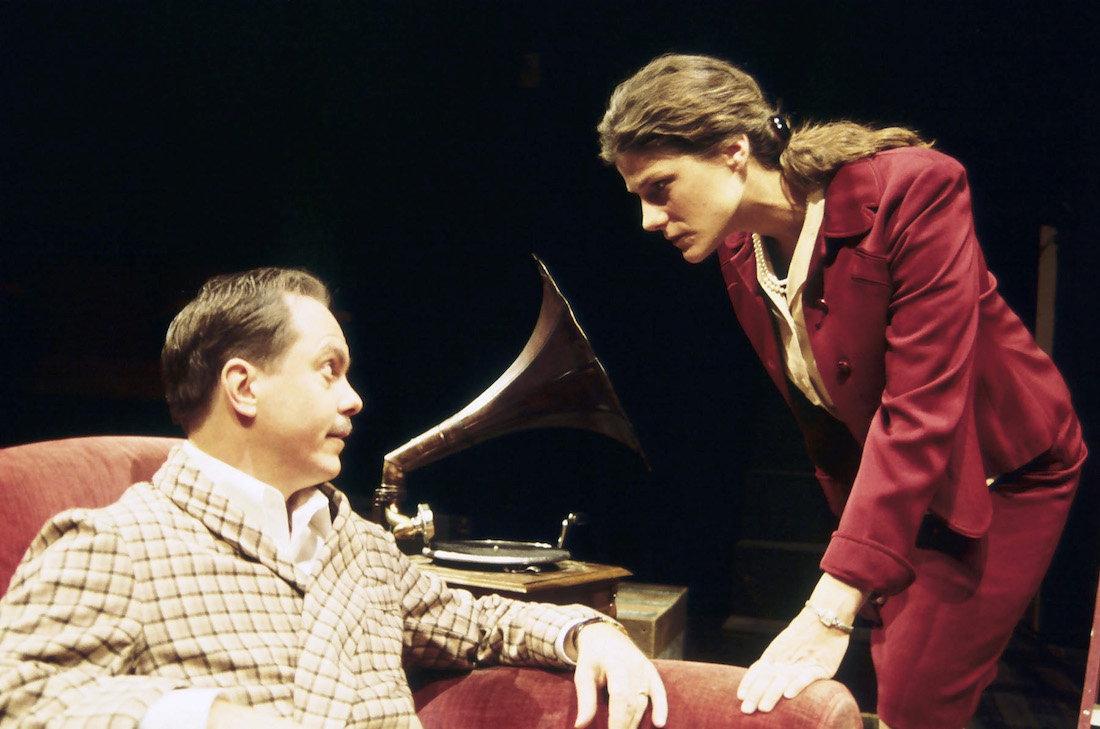
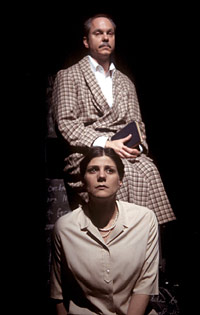
When we first see Arendt (a bravura
turn by Elizabeth Rich), she is writing the equivalent
of a recantation, trying to get Heidigger (the wickedly
good David Parkes) restored to the faculty of a German
university. It is just after the war, and no one will
hire him or publish him. She writes the letter even
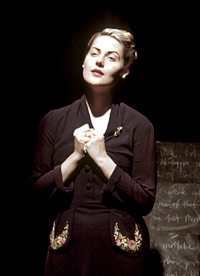
as her own devoted assistant, Alice (Linsey Page Morton),
expresses her outrage and disappointment, and even after
she hears from Karl Jaspers and his Jewish wife, Gertrud
(Larry Baldacci and Isabel Liss), that their "friend"
Heidigger turned his back on them when they needed his
help.
Arendt also writes her letter in
the wake of a grand conflagration--her own postwar visit
to Heidigger that erupts in blazing verbal fireworks
and moral heat. She finds her mentor and ex-lover a
broken man, though still tremendously arrogant. And
while she is no longer in love with him, he still exerts
a power over her. The penning of the letter is an act
of tremendous moral ambivalence for Arendt, but one
she justifies as being consistent with her belief that
no voice should be silenced. And it is this letter,
as well as her meditation on an ongoing war crimes trial
involving another teacher, Baldur Von Schirach (Scott
Mullins)--formulator of the Hitler Youth movement--that
serves as the catalyst for Arendt's re-examination of
her life and her stormy relationship with Heidigger.
When Arendt first met him she was
a graduate student, and he was already an established
academic. He also was married to Elfride (expert work
by Danica Ivancevic), a shrewd but traditional woman
who would become an impassioned devotee of the Nazis.
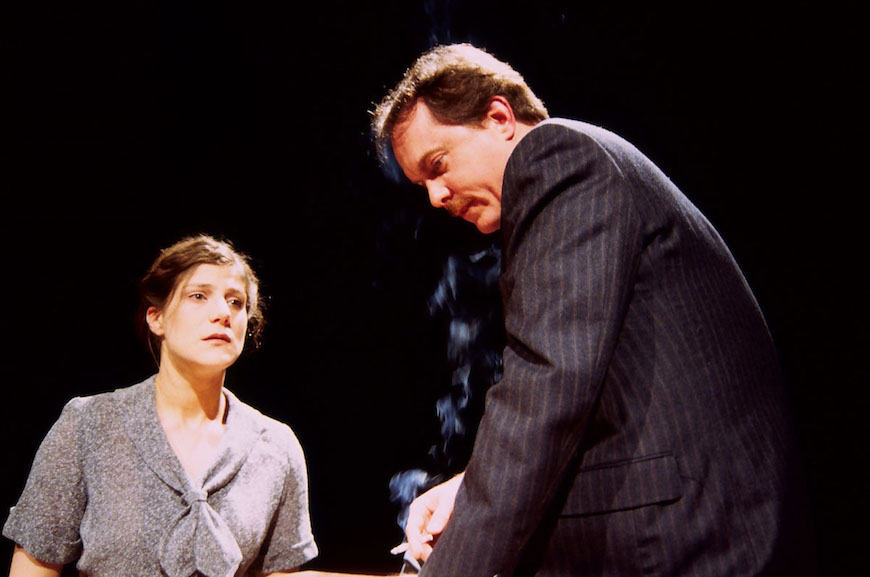
A charismatic and supremely selfish man, Heidigger was
beguiled by Arendt, then a somewhat naive, feverishly
intellectual and emotionally intense young woman, who
also happened to be lonely and idolatrous. In a neatly
symbolic moment, he both seduces her and teaches her
to smoke. Talk about sex and death.
Arendt will go on to marry a young
Jewish colleague, Gunther Stern (perfectly captured
by James William Joseph), although their marriage collapses
in the chaos of wartime exile. She will soon become
a major force in academic America. But she will never
be entirely free of Heidigger.
Amazingly, "Hannah and Martin"
is the first playwrighting effort of Fodor, a Brooklyn-based
writer who works as an editor at Reuters. It was workshopped
at New York's Epic Theater Center and already has received
a major prize, the Kennedy Center's Roger L. Stevens
Award. It should have a starry future, though I doubt
it will get a stronger production than the one now at
TimeLine.
Rich, who left a strong impression
on various roles in "Cider House Rules," has
put an indelible stamp on Arendt, endowing her character
with a passion, intelligence and explosive energy that
do not let you go. She has this woman down, both inside
and out.
Parkes, so deliciously wicked as
Moe Axelrod in "Awake and Sing!," has captured
Heidigger's Svengali-like quality and downfall to brilliant
effect. Real sparks fly between him and Rich, and it
is thrilling to watch them at work.
Fodor's "Hannah and Martin"
arrives right on the heels of Shattered Globe Theatre's
widely heralded revival of "Judgment at Nuremberg."
And it stands as a golden bookend.
|