Hannah and Martin
back
to Hannah and Martin home
Review of Hannah and Martin
- Highly Recommended
reviewed by Tom Williams
Chicago Stage Talk
5/10/03
“There are no dangerous
thoughts; thinking itself is dangerous. To think and
to be alive are the same.”
“Promises are the uniquely human
way of ordering the future, making it predictable and
reliable to the extent that this is humanly possible.”
”The sad truth is that most
evil is done by people who never make up their minds
to be good or evil.”
—Hannah Arendt
TimeLine Theatre gets it right most
of the time. Judgment…which plays to produce…whom
to cast…and who should direct. Three shows: Awake
and Sing!, Hauptmann and now, Hannah and Martin all
fantastic shows! They ‘know’ quality theatre
and they produce mind-bending art. TimeLine is one of
those theatres where you can just order tickets and
not be worried about the name of the play since they
always select tremendous plays. Hannah and Martin is
another proper selection. I was mesmerized from the
first few lines of dialogue.
Kate Fodor’s World Premiere, Hannah and Martin,
is a smart, wordy piece of fiction based on real people
during world changing times. Fodor’s script is
rich with long diatribes from the two philosophers as
they discuss and argue the merits of truth, humanity,
reason, nationality and political ethics. Fodor never
bores us, a testimony to brilliant writing together
with proper direction, pacing and fantastic acting.
We hear German accents throughout, yet nothing suffers.
We hear all the nuances and the subtleness.
Hannah and Martin’s intelligence
implores us to remember that special teacher/professor
whom we idealized, even worshipped as we became focused
on their subject. Hannah and Martin is based on the
life of the Jewish political theorist Hannah Arendt
(1906-1975) and her lover, the renowned philosopher
Martin Heidegger (1889-1976), who became a vocal supporter
of Hitler during World War II and never publicly relinquished
his ties to the Nazi party. This is a fictionalized
version of the story. While the central facts and themes
are based on historical accounts, the play takes liberties
large and small for dramatic purposes. The result is
stunning. The debates and arguments Hannah and Martin
go through in act two are a symposium on modern philosophical
thought.
Two geniuses’s struggle to deal with arrogance,
personal accountability and forgiveness. Who is to judge
whom? Fodor never resorts to TV sitcom or made-for-TV
versions of history where everyone forgives and forgets.
This play has smart, reasonable conclusions that were
in keeping with the characterizations presented. Hannah
doesn’t forgive Martin for his Nazi collaboration
and Martin never displays remorse for his actions.
What gives this work its power is
the talent of the cast. Director Jeremy B. Cohen finely
tuned each character; the supporting members were wonderful.
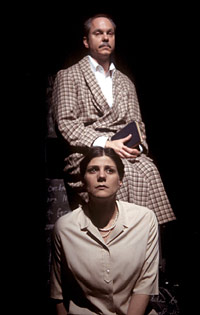
Danica Ivancevic as Elfride Heidegger (Martin’s
wife) was wicked and cold while James William Joseph
as Gunther Stern was vulnerable and naive. As good as
the supporting actors were, the play rests upon the
performance of those playing Hannah and Martin.
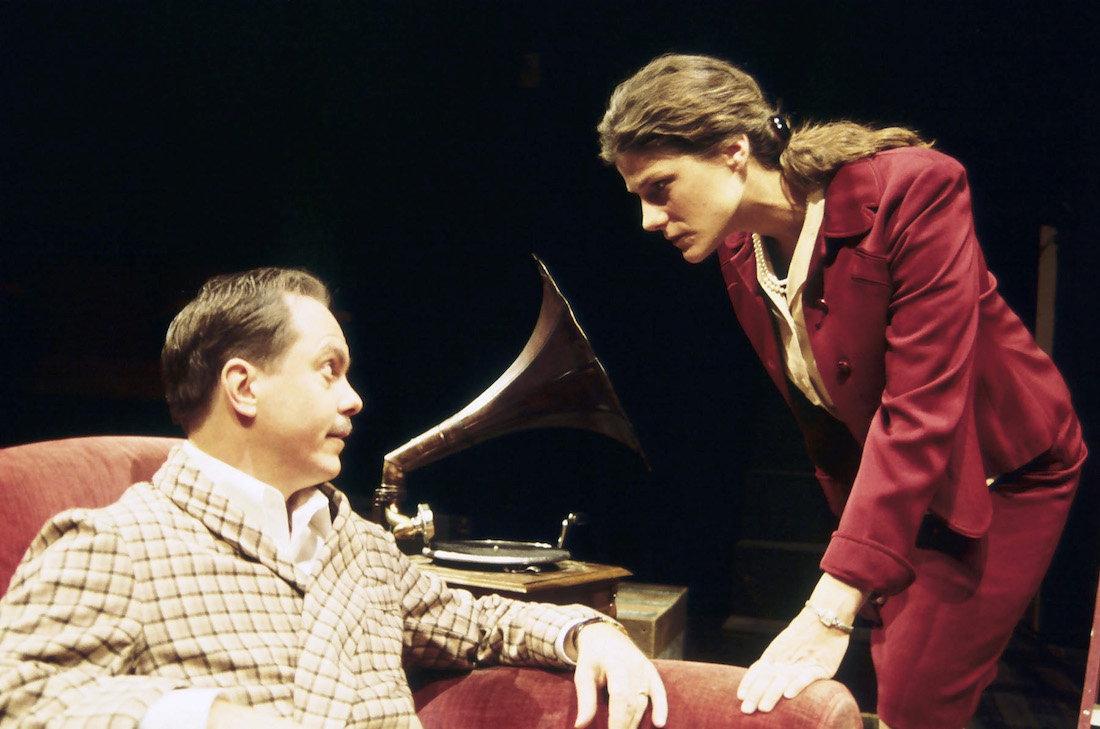
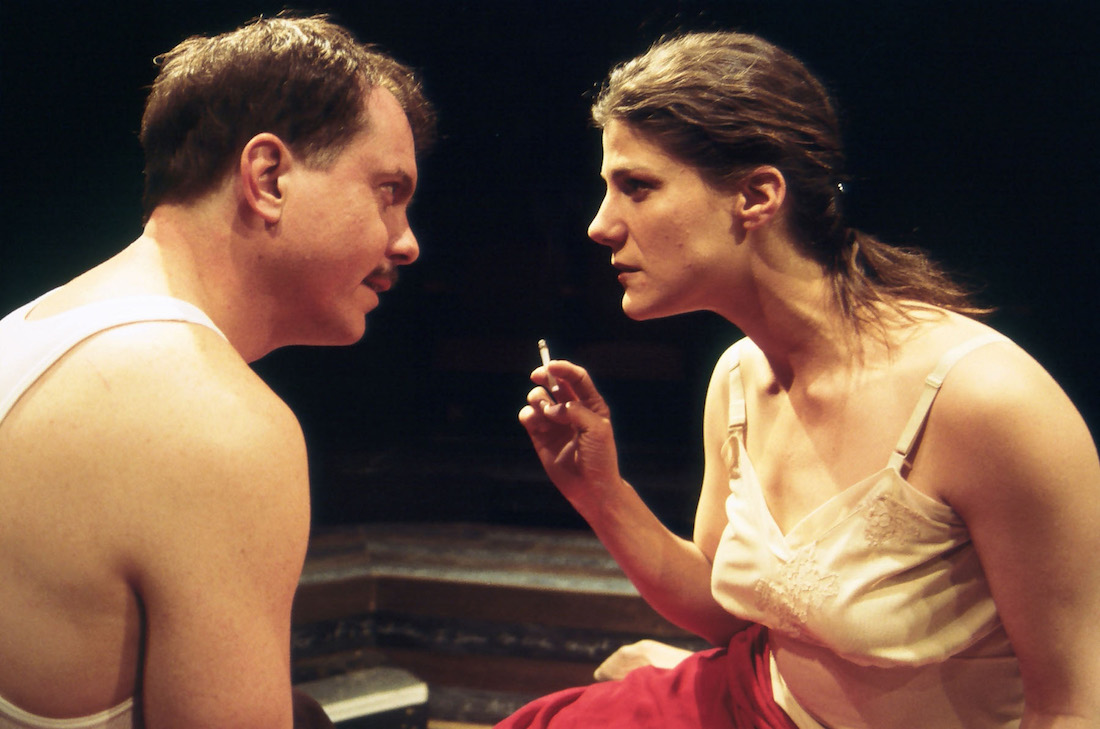
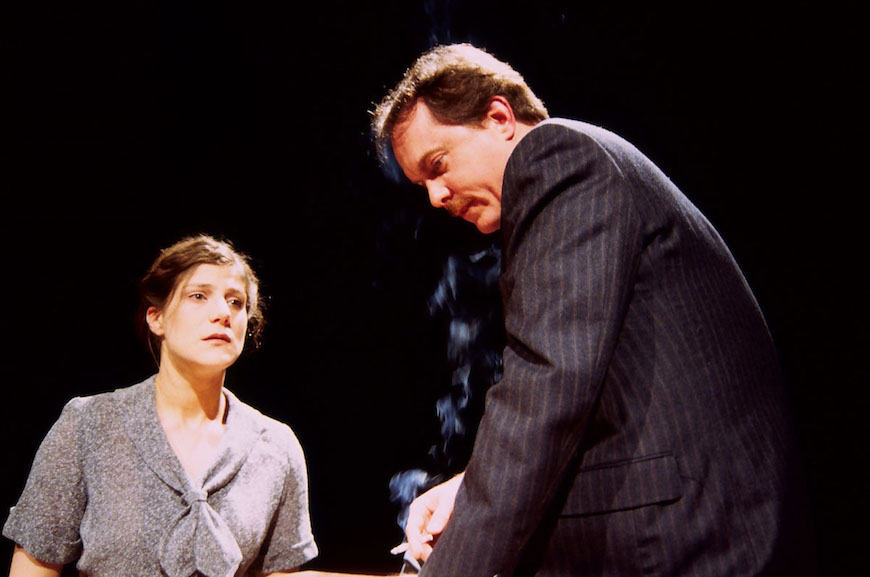
David Parkes as Martin Heidegger had
the presence, the charm, the charisma and the arrogance
to make Martin the intimidating personality who could
win the female student as a lover and easily dispose
of her as his career dictated. Parkes has a fine German
accent and the elocution skills necessary to be convincing
as the German philosopher. Parkes is a marvelous actor.
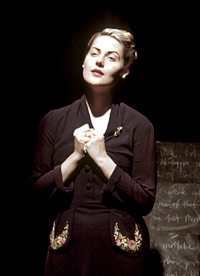
Elizabeth Rich gave the best performance
I’ve seen this year as Hannah. Her body language
went from star-struck student, nervous in front of her
mentor/lover to suave, confident sophisticated public
speaker and hard-driving intellectual. Elizabeth Rich
smoothly takes her character through her emerging persona
in a convincing intense portrayal of the strong intelligent
female. Rich moves on stage with the grace and vigor
of a Katherine Hepburn or a Joan Crawford. Rich’s
quiet power lies in her non-verbal glances and stares.
Elizabeth Rich’s tour de force performance beckons
a Jeff award.
Get to TimeLine Theatre to witness
history and theatre in a special blend with some philosophical
thoughts thrown in just for measure. You’ll enjoy
this exercise in drama. It’ll satisfy your intellect
and leave your thirst for entertainment quenched.
“What makes it so plausible to assume that hypocrisy
is the vice of vices is that integrity can indeed exist
under the cover of all other vises except this one.”
“Love, by its nature, is unworldly,
and it is for this reason rather than its rarity that
it is not only apolitical but anti-political, perhaps
the most powerful of all anti-political human forces.”
—Hannah Arendt
|